
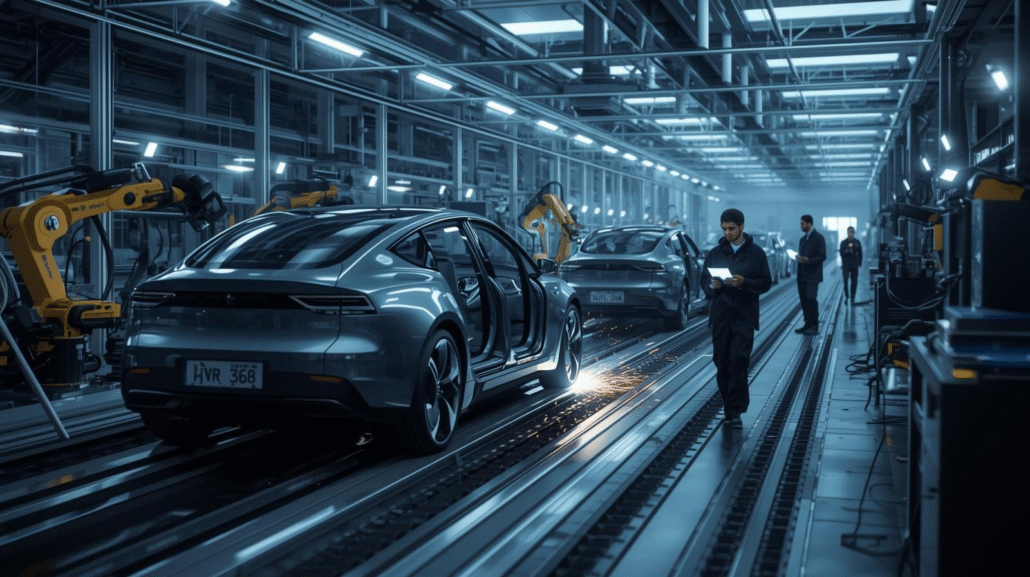
The European Automotive Industry at a Crossroads
Between Electrification and Economic Realism
The transition toward fully electric mobility is becoming increasingly complex. Leaders from Stellantis and Mercedes-Benz have warned that a rigid implementation of the 2035 ban on the sale of internal combustion engine vehicles could trigger a severe recession within the European automotive industry. The debate reopens a fundamental question: how can the balance between climate objectives and the economic sustainability of the sector be maintained?
Context of the Debate
According to the Financial Times, leaders of major European automotive groups are calling for a review of the full electrification timeline. Their argument is that markets and production chains cannot sustain a complete transition by 2035 at the current pace without major social and economic costs.
Industry estimates point to a potential decline of up to three million vehicles per year if EU regulations remain unchanged.
At present, the European legal framework maintains its core objective: a 100% reduction in CO₂ emissions for new passenger cars, effectively allowing only zero-emission vehicles from 2035 onward.
What Manufacturers Are Calling For
- Technological neutrality – recognition of the role of intermediate technologies, such as hybrids, e-fuels, and low-emission combustion engines, in ensuring a balanced transition.
- Flexible phasing – staged achievement of the 2025–2030 targets to avoid penalties and market destabilization.
- Avoidance of industrial shocks – protection of jobs and supply chains, particularly in Central and Eastern Europe.
The Position of the European Commission
The European Commission maintains the 2035 target as a non-negotiable commitment, while exploring mechanisms to adjust intermediate milestones. These include:
- “compliance windows” for manufacturers,
- support schemes for factory conversion,
- additional funding for charging infrastructure and logistics chain digitalization.
Nevertheless, Brussels emphasizes that postponing the transition is not an option.
Economic and Geopolitical Implications
- Global competitiveness: Chinese electric vehicle manufacturers are entering the European market aggressively, offering price and technology levels that are difficult to match.
- Strained supply chains: semiconductor shortages and high energy costs continue to erode European OEM margins.
- Social pressure: the reduction of conventional production capacity could affect tens of thousands of jobs, particularly in Eastern Europe.
Romania and Eastern Europe: Between Opportunity and Risk
Romania has a strategic window to attract investment in electric vehicle components and ADAS systems. To capitalize on this opportunity, several conditions are essential:
- stable industrial policies and clear fiscal incentives;
- charging infrastructure connected to European networks;
- OEM–university partnerships to develop digital and technical skills.
Without these elements, the region risks becoming merely a consumption market for Asian imports rather than an active participant in the European value chain.
Possible Scenarios for 2026–2030
Scenario A – Fixed Target, Flexible Transition
The 2035 target remains in place, but implementation of intermediate steps is adapted. This is the most realistic scenario, preserving environmental direction without destabilizing the market.
Scenario B – Structural Relaxation
A potential reconsideration of the 2035 ban in the event of a prolonged recession. An unlikely scenario, but possible if economic impact becomes critical.
Scenario C – Rigid Status Quo
Strict enforcement of current rules without flexibility. This could accelerate Europe’s loss of market share in favor of Asia.
The CarIntellect Perspective
Europe is at the most sensitive point of its industrial transition.
The shift toward full electric mobility is inevitable, but the approach must be pragmatic rather than dogmatic. The risks are real—job losses, economic imbalances, and intense global competition—but they can be transformed into opportunities through coordination between industry, governments, and research centers.
For Romania, the challenge is clear: not merely to adapt, but to anticipate. A predictable framework, robust infrastructure, and an intelligent industrial strategy can turn this transition into a regional competitive advantage rather than a vulnerability.
Disclaimer
This article is the result of independent research, technical experience, and individual studies conducted by the CarIntellect founder, Eng. George-Adrian Dincă. The content is provided exclusively for informational and educational purposes and does not represent the position of any institution, company, or legal entity. All data and interpretations are based on publicly available technical sources and observations from professional practice, aiming to support a correct understanding of technological progress within the automotive industry.

- Mircea Lucescu. Despre rigoare, construcție și căutarea neobosită a perfecțiunii
- Criza energetică și viitorul mobilității
- Autonomia auto: între promisiune tehnologică și vulnerabilitate sistemică
- Poate un hacker să provoace un accident în masă într-un oraș autonom?
- Cum ar trebui omologate vehiculele autonome într-o eră a atacurilor cibernetice


Lasă un răspuns
Want to join the discussion?Feel free to contribute!