
Automotive Retrospective 2025
New Directions in a Year of Returning to Realism
The year 2025 marked a deliberate shift in the automotive industry away from optimistic promises and into a phase of lucid recalibration. Manufacturers, authorities, and consumers began to assess decisions through a shared lens: what is technically feasible, economically sustainable, and deliverable in the short to medium term. The result was a more mature, less speculative climate, closer to actual market realities.
Electrification Between Consolidation and Pragmatism
After years of accelerated growth, the electric vehicle market entered a more tempered phase. In 2025, several clear directions emerged:
- the premium segment and fleet customers continued to support demand
- the affordable segment slowed under pressure from vehicle prices and energy costs
- consumers demanded realistic range, efficient thermal systems, and predictable ownership costs
- manufacturers reduced experimental launches, focusing instead on models with genuine volume potential
The models that performed best were those optimized for cost: multi-energy platforms, modular architectures, and improved LFP batteries. Small electric vehicles gradually returned to the discussion, while commercial fleets became an important pillar for volume stabilization.
Mature markets avoid extremes. The dominant strategy in 2025 was investment calibrated strictly to demand.
Internal Combustion Engines and Hybrids Retain Their Role
The debate surrounding the 2035 horizon became more pragmatic. Industry called for clarity rather than symbolic postponements. The realities of 2025 included:
- modern hybrid systems becoming key compliance solutions
- small, efficient combustion engines remaining in demand in emerging markets
- synthetic fuels being viewed as niche solutions for premium segments and specialized fleets
There was no talk of a “return” of the classic engine, but rather of its rational use where full electrification is not yet infrastructure-ready or economically viable.
ADAS and Autonomy: Technical Progress, Greater Skepticism
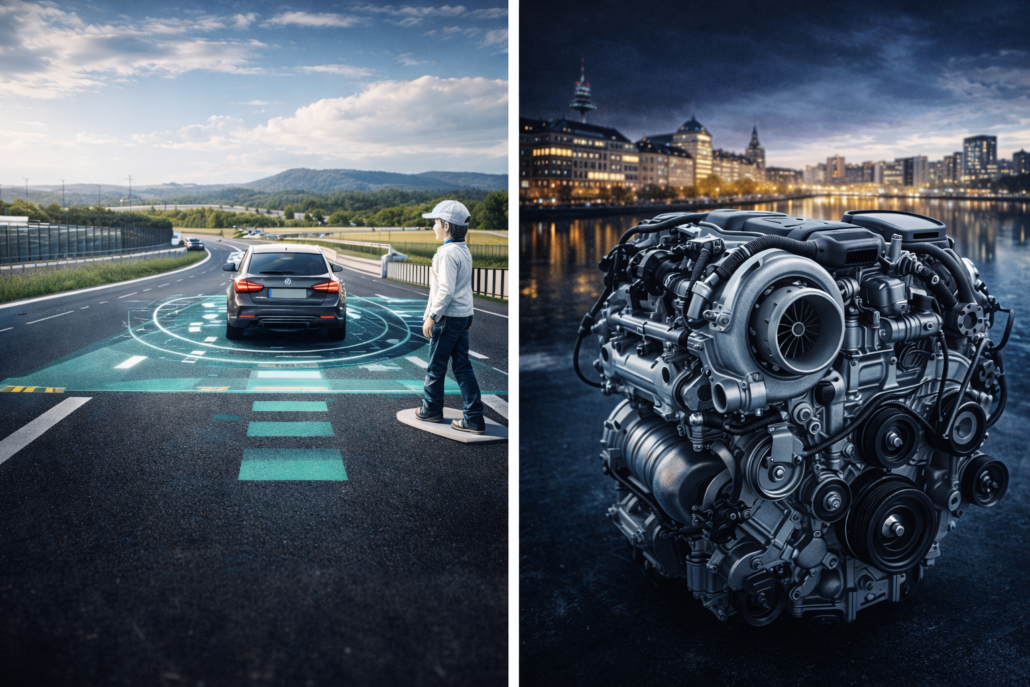
Although technology continued to advance, 2025 brought a structural issue into focus: inconsistency. Independent testing and user feedback highlighted:
- unpredictable behaviour in dense traffic
- significant performance differences between manufacturers
- a growing emphasis on reliability rather than marketing-driven promises
In response, investment in testing increased noticeably. Dedicated ADAS test tracks, complex scenarios, sensor validation, and increasingly serious discussions on harmonized performance regulation became central themes.
Restructuring in the European Automotive Industry
Cost pressure and global competition accelerated structural changes:
- optimization of production networks
- supplier consolidation
- shared platforms across multiple brands
- relocation of certain capacities to lower-cost regions
Chinese manufacturers expanded their presence in Europe not only through imports, but also via local production, reducing logistical and commercial risks.
Battery Technology: Stable Evolution Without Disruption
In 2025, solid-state batteries remained in pilot phases. Real progress came from incremental improvements:
- higher energy density in NMC and LFP chemistries
- lower costs across the supply chain
- extended service life
- more efficient thermal management
The direct beneficiaries were urban electric utility vehicles and fleets, where total cost of ownership outweighs peak performance.
The European Consumer in 2025
Purchasing behaviour changed visibly:
- increased interest in compact, easy-to-maintain vehicles
- reduced attraction to demonstrative features
- stronger focus on reliability and total cost of ownership
- growing popularity of simple hybrids without charging dependency
Infrastructure disparities and energy costs influenced decisions more strongly than in previous years.
Software, OTA Updates, and Digital Ecosystems
The year 2025 confirmed the central role of software:
- more frequent and stable OTA updates
- clearer limits on subscription-based features
- digital platforms valued only if they are fast and intuitive
Complexity ceased to be an advantage. Predictability became the key criterion.
Urban Mobility: Necessary Corrections
European cities adjusted overly ambitious plans. Dominant directions included:
- priority for electric public transport
- functional multimodal hubs
- electric fleets for urban deliveries
- predictive traffic management
Environmental regulations remained firm, but with pragmatic exemptions for the commercial segment.
Global Trends Impacting Europe
- uneven electrification progress in the United States
- Asia’s dominance in battery and semiconductor production
- intensifying alliances between manufacturers
- affordable vehicles becoming the central competitive battleground
Europe continues to search for a balance between regulation, competitiveness, and the protection of its industrial base.
How the Industry Enters 2026
The automotive industry enters 2026 more tempered, yet more coherent. The lessons of 2025 are clear:
- steady technological progress without unrealistic promises
- continued electrification, aligned with actual demand
- ADAS and software as genuine differentiators
- more informed and selective consumers
- manufacturers forced to be efficient and predictable
The automotive sector remains in profound transformation, but enters 2026 with clearer direction and strategies aligned to economic and technological realities.
Disclaimer
This article reflects the analysis and professional opinions of the CarIntellect founder, based on experience in the automotive and mobility sectors, specialized studies, publicly available data, and direct observation of industry developments. The content is provided for informational and analytical purposes only and does not represent commercial or investment recommendations, nor official positions of manufacturers, authorities, or organizations. Interpretations are made in good faith, within the limits of the information available at the time of writing.

Where motion meets intellect
Recent impressions