
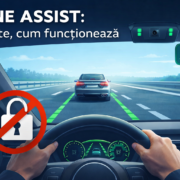
Lane Assist: what it is, how it works, and why it does not “lock the steering wheel”
Lane keeping assistance systems have become, in recent years, a frequent topic in public debate. On the one hand, they are presented as an important advance in road safety. On the other hand, alarmist reports periodically appear, associating them with loss of control or serious accidents.
In reality, the gap between how the system works from a technical perspective and how it is perceived by the driver is at the core of most of these controversies.
What Lane Assist actually is

Lane Assist, also known as Lane Keeping Assist, is an ADAS system designed to reduce the risk of unintentional lane departure. It is not an autonomous driving system and it is not intended to “keep the car on the road” in the absence of the driver.
Its function is limited to:
- detecting deviation from the driving lane,
- applying a mild steering or braking correction,
- warning the driver, depending on system configuration.
Responsibility for steering remains, at all times, with the driver.
How Lane Assist works, step by step
Despite common perceptions, the system operates in a relatively straightforward way and is based on three distinct stages.
1. Detection
A forward-facing camera, usually mounted near the interior rear-view mirror, identifies road markings. The system does not “see the road” like a human driver. Instead, it analyzes specific visual contrasts, such as solid or dashed lines and lane edges.
2. Interpretation
Based on the captured images, the software estimates the vehicle’s position and the probability of an unintentional lane departure. Several variables are correlated, including vehicle speed, steering wheel angle, turn signal activation, and the presence of continuous driver input.
3. Intervention
When predefined conditions are met, the system may:
- apply a small steering torque via the electric power steering,
- selectively brake one of the wheels,
- or issue visual or audible warnings only.
The applied torque is strictly limited by design and can be immediately overridden by the driver.
Since when has Lane Assist existed?
The first lane departure warning systems appeared in the early 2000s. Active steering correction entered series production around 2004. Between 2010 and 2018, the technology rapidly expanded into mid-range vehicle segments, and after 2018 it became an integral part of European safety assessment protocols.
Today, Lane Assist is standard equipment on most new vehicles sold in the European Union.
“The steering wheel locked”: what technical analysis shows
The claim that Lane Assist can lock the steering wheel is not technically supported. Electric power steering systems:
- do not contain mechanical locking mechanisms,
- operate exclusively by applying controlled torque,
- are designed so that the driver always has absolute priority.
In situations reported as “lock-ups,” the typical sequence is the following: the driver initiates a maneuver without signaling, the system interprets the deviation as unintentional, and applies an opposing correction. The resulting resistance is perceived as unexpected feedback, not as a mechanical failure.
Factors that can create confusion
Post-accident analyses often reveal factors overlooked in media reports: worn or temporary road markings, poorly marked roadworks, wet or dirty pavement, missing signage, or system use outside its recommended operating conditions.
Under such circumstances, Lane Assist may reduce its intervention or temporarily deactivate.
Myths and reality
The idea that Lane Assist “takes control” is one of the most persistent misconceptions. The system applies only limited corrections and only in the absence of clear driver input. It is not autonomous, does not anticipate intentions, and does not replace human attention.
A human–machine interface issue
From an engineering standpoint, Lane Assist is functionally correct, yet not always intuitive. Steering resistance is intentional, but it is not always clearly explained or understood by drivers. The difference between “helpful” and “intrusive” can arise in fractions of a second and is more closely related to user expectations than to technical limitations.
Conclusion
Lane Assist is neither experimental nor infallible. It is a mature system, well understood from an engineering perspective, designed to intervene selectively in well-defined situations rather than to manage the full complexity of real-world traffic. It performs correctly when infrastructure is legible, road markings are clear, and the driver uses it within its intended parameters.
Problems arise when user expectations exceed the system’s purpose. Lane Assist does not know the driver’s intentions and cannot interpret context in a human way. It reacts strictly to detected deviations and the absence of clear input. In such moments, its correction may feel like resistance, especially when the driver does not anticipate the intervention.
Incidents in which the system is cited as a triggering factor rarely point to a design flaw or a loss of mechanical control. They more often highlight the limits of human–machine interaction, particularly in real-world driving conditions where markings are incomplete, temporary, or contradictory.
Lane Assist reduces certain types of errors, but it does not eliminate them. It does not replace attention, compensate for poor decisions, or correct a lack of anticipation. Like any ADAS feature, it is effective only when properly understood, accepted as limited assistance, and used consciously.
The uncomfortable truth is this: the technology operates according to specifications, but it cannot correct user misunderstanding. And where understanding is missing, even the most carefully calibrated algorithm cannot prevent incorrect reactions behind the wheel.

Disclaimer
This article is intended for informational and technical purposes only. The analysis is based on engineering principles, declared ADAS system functionality, and publicly available data. It does not constitute legal advice, accident expertise, or an assessment of any specific case. The performance of driver assistance systems varies depending on manufacturer, configuration, technical condition, road environment, and usage. Responsibility for vehicle operation remains with the driver at all times.
- Mircea Lucescu. Despre rigoare, construcție și căutarea neobosită a perfecțiunii
- Criza energetică și viitorul mobilității
- Autonomia auto: între promisiune tehnologică și vulnerabilitate sistemică
- Poate un hacker să provoace un accident în masă într-un oraș autonom?
- Cum ar trebui omologate vehiculele autonome într-o eră a atacurilor cibernetice





Recent impressions