

Passive Safety in the ADAS Era
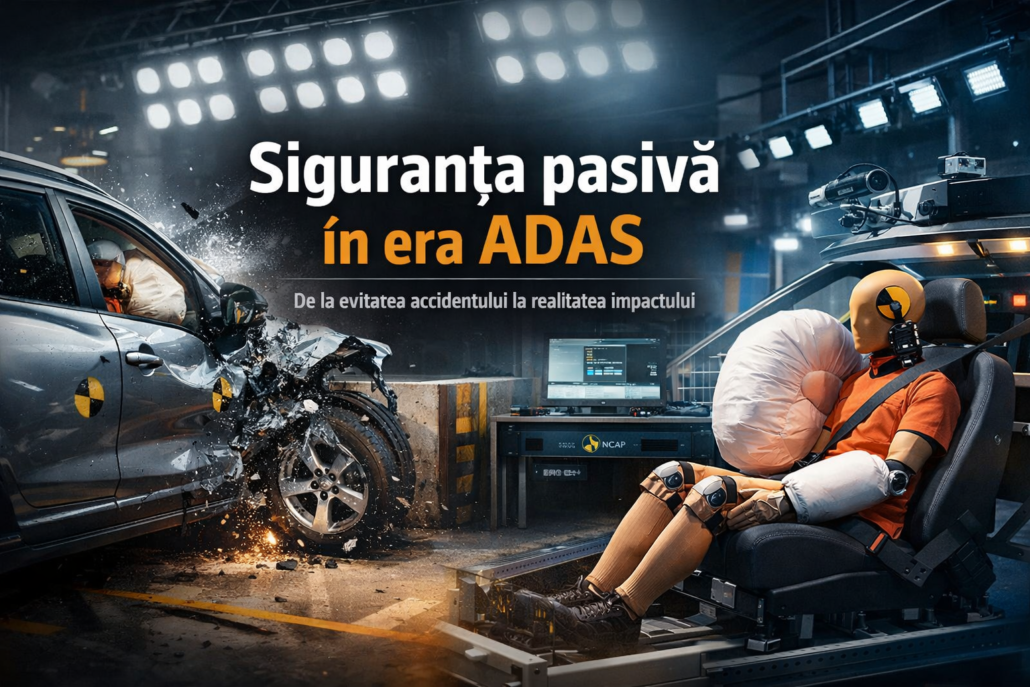
From the promise of accident avoidance to the reality of impact
Over the past decade, public discourse on automotive safety has shifted almost entirely toward ADAS systems. Automatic emergency braking, lane keeping assistance, and steering interventions are often presented as signs of steady progress toward increasingly rare accidents.
This shift in focus has pushed passive safety into the background, even though engineering reality points in the opposite direction: as ADAS becomes ubiquitous, the importance of the vehicle structure, restraint systems, and airbags increases rather than diminishes.
ADAS reduces risk, it does not eliminate accidents
ADAS systems are designed for prevention. They can reduce the likelihood of an accident, mitigate an incorrect maneuver, or gain a few critical fractions of a second. However, they cannot completely eliminate accidents.
When prevention fails, the physics of the impact becomes the decisive factor. Kinetic energy must be dissipated, and the way in which the vehicle structure deforms in a controlled manner directly influences the severity of occupant injuries.
At this point, passive safety remains the final and most important level of protection.
Vehicle structure in an increasingly complex architecture
The integration of ADAS fundamentally changes vehicle architecture. Radar sensors, cameras, control units, and wiring are placed in areas that were traditionally dedicated to energy absorption during a crash.
This overlap creates a real engineering challenge: the structure must deform in a controlled way while simultaneously protecting critical electronic components. An incorrect compromise can affect both ADAS performance and structural behavior in a collision.
Airbags are not a “finished” technology

Public perception often treats airbags as a mature solution that has remained unchanged for years. In reality, they continue to evolve.
Modern airbags are becoming adaptive, with deployment strategies adjusted according to impact severity, occupant position, and pre-crash data provided by ADAS systems. Integrating information from the moments before a collision allows for more precise calibration of the protection sequence.
Passive safety is not static. It is becoming increasingly data-dependent.
Why physical testing remains indispensable
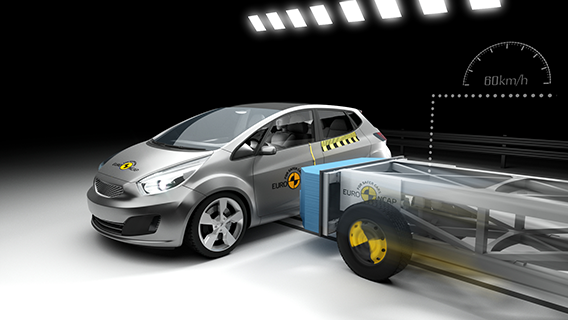
Physical testing remains the only method through which these cumulative effects can be fully validated. Only real-world impact tests can confirm whether the structure deforms as intended, whether load paths are correctly managed, and whether restraint systems operate in synchronization with occupant dynamics. The interaction between seat belts, airbags, seats, and the vehicle structure is extremely sensitive to details that digital models can approximate but cannot fully reproduce.
In the context of ADAS, the importance of physical testing increases further. Active safety systems can modify pre-impact conditions, residual speed, collision angle, or occupant position in the fractions of a second before impact. These variations directly influence how passive safety systems must respond. Validating this complete chain, from pre-impact to energy dissipation and occupant protection, cannot be achieved through digital simulation alone.
Thus, physical testing is not a tool of the past but a critical reality check. In the ADAS era, it does not disappear; it evolves into a more integrated, more frequent process, closely linked to development, ensuring that digital progress does not compromise real-world protection at the moment of impact.
Regulations, assessments, and their limits
The technical regulatory framework remains mandatory regardless of the level of digital assistance. UNECE regulations define minimum safety requirements, while Euro NCAP assessments provide a comparative view of vehicle performance.
It is important to emphasize that these assessments do not replace homologation; they complement it. A high score does not override fundamental structural requirements, nor does it substitute conformity testing.
Modern laboratories: more than testing facilities
Safety laboratories are no longer simple locations where tests are performed at the end of development. They are becoming integration hubs between design, validation, and homologation.
This evolution is driven by time pressure, increasing vehicle complexity, and the need for rapid validation cycles.
Eastern Europe’s missed opportunity
Eastern Europe currently holds a solid position in the European automotive production chain. The region hosts assembly plants, structural component factories, restraint system production, wiring harnesses, electronic components, and engineering centers primarily focused on industrial support. Despite this, its role in validation, advanced testing, and homologation remains marginal.
This separation is not accidental. Passive safety testing infrastructure requires significant investment, long-term know-how, and close interaction with regulatory authorities. Traditionally, these capabilities have been concentrated in Western Europe, where historical decision-making, development, and homologation centers were established. Eastern Europe has been viewed mainly as a cost-efficient production region rather than a validation hub.
The problem is that this logic is becoming inefficient. Modern vehicles are far more complex, development cycles are shorter, and the integration of ADAS with structural and passive safety systems requires rapid iterations between design, testing, and correction. Geographic distance between factories, engineering centers, and testing laboratories slows processes and increases logistical costs.
In practice, many critical components produced in Eastern Europe are tested and validated hundreds or even thousands of kilometers away. Any non-conformity discovered late leads to delays, redesigns, and additional costs. In this context, the absence of regional testing centers is no longer merely an issue of industrial status but one of economic efficiency and competitiveness.
The growing prevalence of ADAS further amplifies this need. Active safety systems influence impact conditions, and proper validation requires integrated, not sequential, testing. Without local impact testing infrastructure, structural testing, and restraint system evaluation, Eastern Europe remains dependent on external decisions and capabilities, despite its direct contribution to the final product.
What currently appears to be a missed opportunity thus becomes, in the medium term, a strategic risk. Developing regional testing and validation centers would not represent unnecessary duplication but an adaptation to the reality of a faster, more complex, and more integrated industry. Without this step, Eastern Europe risks remaining locked into an incomplete role, essential for production yet underutilized in terms of added value and advanced technical competence.
Conclusion
ADAS changes how we attempt to avoid accidents. Passive safety defines what happens when they occur. Between the two lie testing, infrastructure, and engineering competence.
Real progress does not come from replacing passive safety with digital solutions, but from integrating them coherently into a system that respects the limits of physics and the reality of impact.
Disclaimer
The opinions expressed in this article belong to the founder of CarIntellect and reflect a professional analysis based on experience and information available at the time of writing. They do not represent official positions of institutions, organizations, or entities within the automotive industry and should not be interpreted as statements of conformity, homologation, or commercial recommendations.

- Mircea Lucescu. Despre rigoare, construcție și căutarea neobosită a perfecțiunii
- Criza energetică și viitorul mobilității
- Autonomia auto: între promisiune tehnologică și vulnerabilitate sistemică
- Poate un hacker să provoace un accident în masă într-un oraș autonom?
- Cum ar trebui omologate vehiculele autonome într-o eră a atacurilor cibernetice


Lasă un răspuns
Want to join the discussion?Feel free to contribute!